

Prominent Baloch dishes, such as the lamb-skewed Sajji, have gained massive popularity among different parts of Pakistan including the food hubs of Karachi and Lahore. Kaak, a rock-hard prepared bread, and is often served with Sajji. Dampukht is also a Balochi dish which is prepared with meat and it’s cooked in fats.

games in blochistan


running of the bulls (Spanish: encierro, from the verb encerrar, ‘to corral, to enclose’; Occitan: abrivado, literally ‘haste, momentum’; Catalan: correbous, ‘street-bulls’) is an event that involves running in front of a small group of cattle, typically six[1] but sometimes ten or more, that have been let loose on a course of a sectioned-off subset of a town’s streets,[1] usually as part of a summertime festival. Particular breeds of cattle may be favored, such as the toro bravo in Spain,[1] also often used in post-run bullfighting, and Camargue cattle in Occitan France, which are not fought. Actual bulls (non-castrated male cattle) are typically used in such events.
baloch dance and music
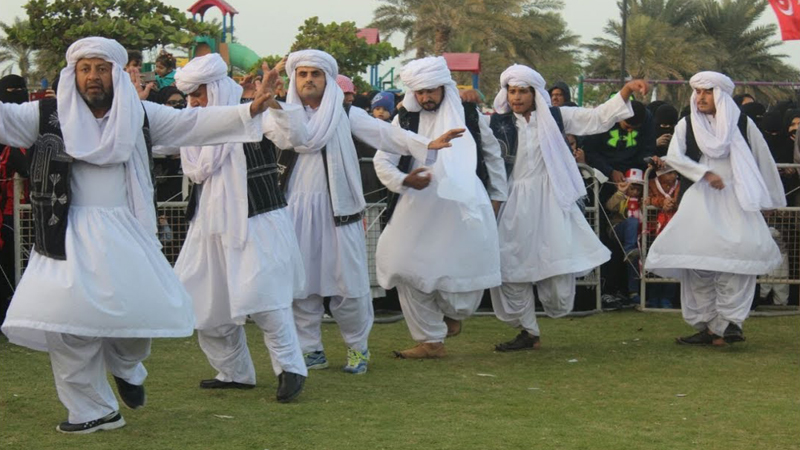
There are countless musical instruments exclusive to Balochi culture. On the verge of extinction one of the most profound rare music sung in Balochistan is Nar Sur. The traditional throat singing is rare and an important component of Balochi folk music. Nar Sur, a unique genre of music, is found in some other parts of the world far away from Balochistan. In Nar Sur, a singer narrates a folk story in a single overtone accompanied with the playing of a twin-flute by a musician.
Baloch festivals

There are religious and social festivals celebrated by the people of Balochistan. Two major religious festivals are Eid-ul-Azha and Eid-ul-Fiter. On these festivals people adorn their houses, wear new dresses, cook special dishes and visit each other. Eid-Meladun-Nabi is another religious festival. It is a celebration of the Holy Prophet’s birthday. Numerous colorful social festivals are also source of jubilation. Sibi festival that traces its roots to Mehergar, an archeological site of ancient human civilization, attracts people from across the country. It is attended by common folks, ministers and other government officials. Folk music performance, cultural dances, handicrafts stalls, cattle shows and a number of other amusing activities present a perfect riot of color. Buzkashi is a peculiar festival showing valour of Balochistan people. It is celebrated on horse-back by two teams that use their skills to snatch a goat from the each other
Balochi dress

The men’s shalwar kameez consists of a very baggy shalwar[1] which uses large lengths of cloth.[2] The kameez is also loose,[3] which traditionally is long with long sleeves[4] The Balochi shalwar kameez is similar to the styles worn in Afghanistan. The present Balochi shalwar kameez replaced the earlier version which consisted of a robe to the ankles and a shalwar using cloth of up to 40 yards.
The female Balochi suit consists of the head scarf, long dress and a shalwar. Balochi women wear loose dresses which are embroidered in local designs which include Balochi silk-thread chain-stitch embroidery.[5] Balochi embroidery alone has 118 different basic designs
 Pak Traditions